LWYR interviews Andrés Jara
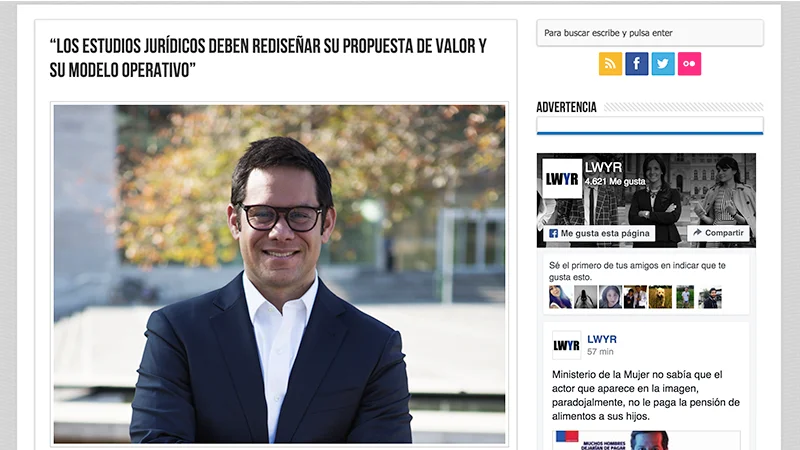
- This is the opinion of the lawyer Andrés Jara, creator of Alster Legal, who adds that the market must begin to incorporate concepts such as project management of legal processes, use of enabling technologies (collaborative platforms), flexible contracts, cost and time efficiency, participatory horizontal structures, smart negotiations and contracts win- winamong others.
Since he started operations in Chile, Alster Legal has given you to talk. Its innovative business model based on horizontal structures and incorporation of Project management tools and remote work has highlighted among the actors in the legal services industry. Alster Legal already has a network of more than 20 advisers throughout Chile and has positioned its founder, Andrés Jara, as the leader of the NewLaw trend in our country and in the region.
So much so, a few days ago they were invited to participate in the Global Summit of Legal Hackers in New York, which brought together lawyers, politicians, software / technology developers and academics worldwide to explore and develop solutions to some of the most urgent problems arising from the intersection between law and technology.
On that occasion, Andrés Jara, together with the Vice Dean of the Law School of the University of Michigan and in charge of the R & D Legal Centre, took over the workshop «Innovation in legal services "in which they explored and developed creative solutions to some of the challenges technology generates in the exercise of the profession within the corporate world.
According to this lawyer from the Pontifical Catholic University of Chile, Master in Law and Business (MLB) of Bucerius Law School (Germany) and Master in Business Administration (MBA) of the Pontifical Catholic University of Chile, it is key to remain at the forefront on issues of trends and legal innovation, as this allows him to meet the growing demands of his corporate clients with innovative solutions that incorporate technology tools and more efficient working methodologies, especially as regards the world of legal management as innate consumers of services of this species.
- How does the idea of creating Alster Legal?
Over the past time, we have witnessed a number of changes in the legal services industry, particularly the emergence of alternative legal service providers who deliver more efficient solutions through technology. The preference of professionals to have greater freedom and flexibility of work and the greater receptivity of customers to charges per project as a counterpart to hourly rates are, of course, an inescapable path.
All of the above, in my view, represents a tremendous opportunity to transform a business area where there is a real need for reinvention, improvement and adaptation to new needs. Understanding these elements, we create Alster Legal, a company oriented to the provision of legal services and legal strategic consultancy through a model that allows to be extremely competitive without giving up quality, as those who provide the advice are professionals with more than 5 years of experience in the exercise of the profession.
- How has market reception been in front of this new model in a heading that is characterized by being more traditional and conservative?
- It has been very good, in fact, our growth is a reflection of it. Today, we have customers from different industries who have found in us a company that is able to deliver a correct conjugation between services and strategic legal consulting. They have also seen their risks materially mitigated, they appreciate significant reductions in their administrative and sales costs in external legal advisers, they meet their expectations for access to information and, consequently, they perceive that our service, rather than a cost, is an investment.
- And how has the labour market been received; there is interest in Chilean lawyers to belong to the Alster Legal?
- Every day we receive requests from professionals interested in joining our team. In this sense, I believe we have been an option for people who, despite their high qualifications and years of experience, prefer to look for different formulas to practice the profession, avoiding being immersed in pyramid structures and having greater control of their faces and lives, but at the same time they are people who seek challenging projects that allow them to have freedom. Everything in a collaborative, horizontal and flexible environment.
Currently, we have Advisors distributed from Antofagasta to Puerto Montt, all high-level professional lawyers with extensive experience, which allows us to have close, quality services and aligned with the interests of our customers and greater physical presence where other industry actors do not have it. In addition, today we are looking to incorporate new Advisors and recruitment campaigns are being a success.
- He was recently called to participate as speakthe Global Summit of Legal Hackers in New York. What lessons did you get from that experience?
- Several. First, it is important to note that there are four major areas where it is necessary to continue exploring and motivating R & amp; D: corporations, governments, universities, NGOs and access to justice.
Secondly, the market must begin to incorporate concepts such as project management of legal processes, use of enabling technologies (collaborative platforms), flexible contracts, cost and time efficiency, participatory horizontal structures, smart negotiations and contracts win-winamong others.
Thirdly, it is key to understand that if legal studies want to maintain or increase their market share and profitability in this new technology-renewed scenario, they must redesign two key elements in their business model: their value proposal (including the service they offer and the billing model) and their operating model (including their cost structure and organizational structure). Chile is not immune to this new era and it is the mission of companies like ours to deliver solutions to these new times. These are times of change and Alster Legal is a reference on that road.
- Finally, what, in your view, are the main challenges for the legal world in this digital age?
- In my view, they are mainly the understanding, construction and identification of meta data, the understanding of the blockchain and the introduction of project management tools and new technologies in the processing of information and automated documentation processing. Also, the applications of innovations in the use of artificial intelligence and the need to generate information sources with policies Open Source they are compatible with public policies on privacy. If properly addressed, they will allow for the introduction of new business models, the activation of competition with proposals of differentiated value, the further democratization of the right and access to justice and the contribution to the transparency and mitigation of the asymmetry of information that exists between the common citizens and the government. Every initiative, in this regard, will create greater opportunities and will no doubt change the environment in which we have exercised the profession for years. That is why we must really be concerned about preparing and providing ourselves with information and knowledge to address these new global trends.
To read LWYR's interview, to the CEO of Alster Legal, click Here.